


Email: stamfordbridge1066@outlook.com
BATTLE OF
STAMFORD BRIDGE
HERITAGE SOCIETY
© Battle of Stamford Bridge Heritage Society
Registered Charity Number 1218868

Website Hosted by

JOIN US
EVENTS
THE BATTLE
SUPPORT US


HOME
Contact Us:

25th SEPTEMBER 1066
THE BATTLE OF STAMFORD BRIDGE
THE DAY THAT CHANGED HISTORY
Explore the critical clash of 1066 that marked
the end of the Viking Age in England
Whilst we all know about the Battle of Hastings on October 14th 1066 and the events
that took place there, few people are aware of the momentous battle that took place
here in Stamford Bridge on September 25th 1066. We also must not forget the battle
of Fulford (20th September 1066) in which the Viking army defeated the English at
York -
The story begins with the death of Edward the Confessor on 5th January 1066; his death left no natural heir to the English throne. Edward was succeeded by Harold Godwinson, who was chosen by the Witenagemot (the English council of nobles and churchmen) and crowned as King Harold II on January 6th 1066. But others saw themselves as the true successor; William of Normandy believed that he had been promised the throne by Edward himself, stating that Harold Godwinson swore a solemn oath on holy relics in 1064 to support William's right to the crown. When Edward died in January 1066, Harold broke this oath and took the throne himself. Meanwhile, King Harald Hardrada’s claim to the English throne in 1066 was based on an old succession agreement between his predecessor, Magnus the Good (King of Norway), and Harthacnut (King of England and Denmark) which agreed that if either king died without an heir, the survivor would inherit both of their kingdoms. Hardrada believed he was the natural heir to this agreement.
It was King Harald Hardrada who led the Viking invasion of England alongside Tostig,
the estranged brother of Harold Godwinson. Their army travelled down the North Sea
coast, raiding as they travelled before reaching York by foot from their harbour
at Ricall on the River Ouse. They defeated the English army at the Battle of Fulford
before reaching an agreement to exchange hostages at Stamford Bridge 5 days later.
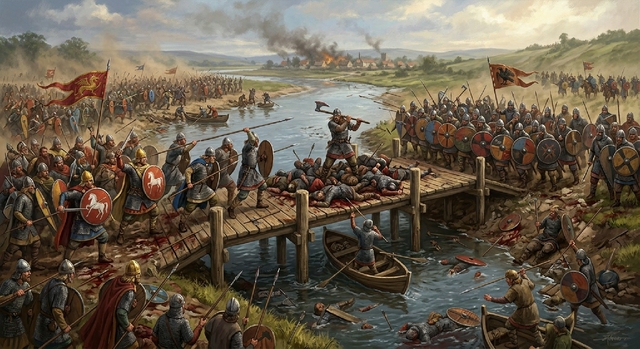
But unbeknown to the Vikings, King Harold of England had made his way North some
180 miles and was to surprise the Viking Army as a cloud of dust appeared over the
horizon. Not expecting to be in battle the Viking had only a limited number of men
and were ill-
Though Godwinson’s victory was absolute, history now recalls how Harold lost to the Norman invaders, led by William of Normandy at Hastings just 19 days later. The significance and scale of the Battle of Stamford Bridge should not be underestimated as a contribution to this loss and the legacy of the events in Yorkshire in 1066 should never be forgotten.